1
Question 1 of 21
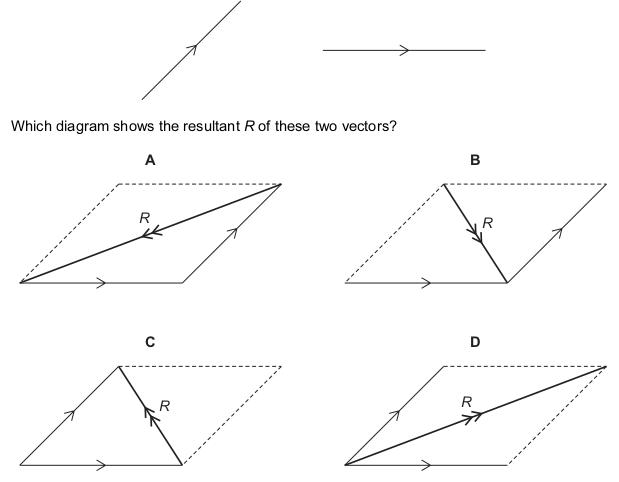
The diagram shows arrows representing two vector quantities.
This Physical Quantities Units and Measurements Quiz 1 quiz contains 21 multiple choice questions designed to help you revise and test your Gcse physics quizzes knowledge. Select an answer for each question and click “Submit Answer” to see instant feedback. Take your time and try to score as high as possible!
Here in this quiz, we shall be having a broader view of the various concepts under Physical quantities, units, measurements, and dimensions. You shall be tested on the identification of measurement parameters, calculation of error, and your understanding of SI units among others. It is going to be an insightful activity taking the quiz.
A physical quantity could be defined as a body or material property that can be quantified and measured. After quantification and measurement, the final results need to be expressed with respect to some standards, and this is when units come in. Units are standards for measurement. Some examples of units are: kilogram (kg), meter(m), Ampere(A), etc. Physical quantities can also be further divided into vectors (physical quantities with magnitude and direction) and scalar quantities (physical quantities with magnitude but no direction).
You might have been having doubts concerning this topic. Here is your chance to clear your mind by solving the quiz. We wish you the best as you practice alongside other exciting physics quizzes.
Question 1 of 21
The diagram shows arrows representing two vector quantities.
Question 2 of 21
Which set of quantities are all vectors?
Question 3 of 21
A student determines the circumference of a golf ball.
Which instrument gives a reading that is the circumference of the golf ball?
Question 4 of 21
Which quantity is a vector?
Question 5 of 21
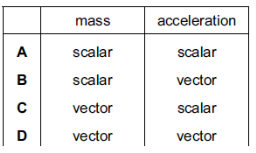
Is mass a scalar or a vector, and is acceleration a scalar or a vector?
Question 6 of 21
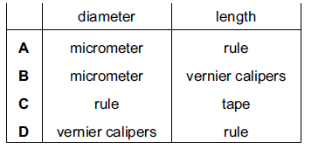
The diameter and the length of a thin wire, approximately 50 cm in length, are measured as precisely as possible.
What are the best instruments to use?
Question 7 of 21
Newton’s third law involves two quantities which are equal in size and opposite in direction.
What is the unit for these two quantities?
Question 8 of 21
Which quantity is a scalar?
Question 9 of 21
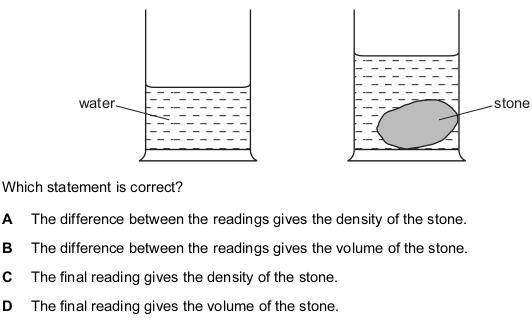
During an experiment to find the density of a stone, the stone is lowered into a measuring cylinder partly filled with water.
Question 10 of 21
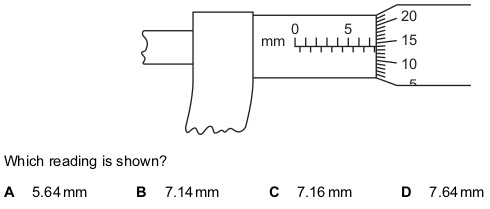
The diagram shows a micrometer scale.
Question 11 of 21
Which is a scalar quantity?
Question 12 of 21
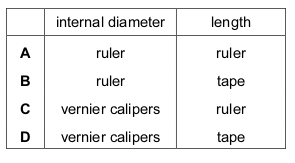
A workman measures, as accurately as possible, the length and internal diameter of a straight copper pipe.
The length is approximately 600 cm and the internal diameter is approximately 2 cm.
What is the best combination of instruments for the workman to use?
Question 13 of 21
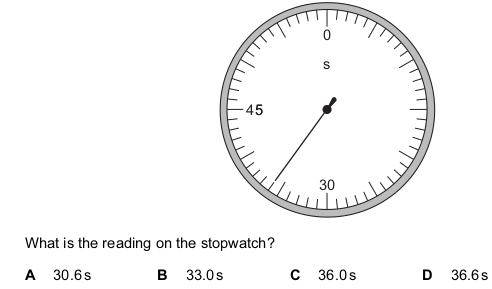
The diagram shows a stopwatch.
Question 14 of 21
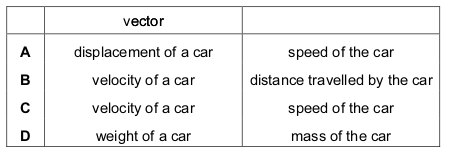
Each row contains a vector and a scalar.
In which row is the size of the vector equal to the size of the scalar?
Question 15 of 21
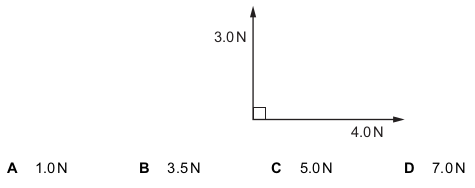
What is the size of the resultant of the two forces shown in the diagram?
Question 16 of 21
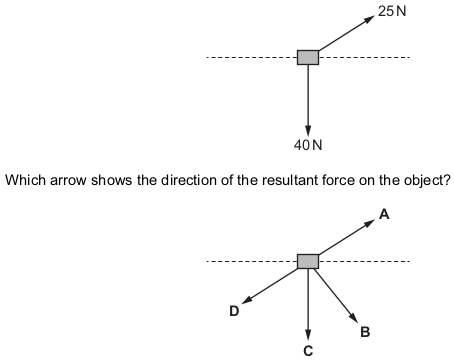
Forces of 25 N and 40 N act on an object in the directions shown.
Question 17 of 21
Which device can be used to measure the thickness of a single sheet of paper?
Question 18 of 21
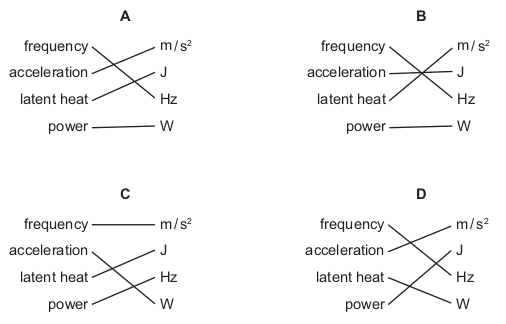
In a test, four students linked the quantities on the left with their units on the right.
Which student matched them all correctly?
Question 19 of 21
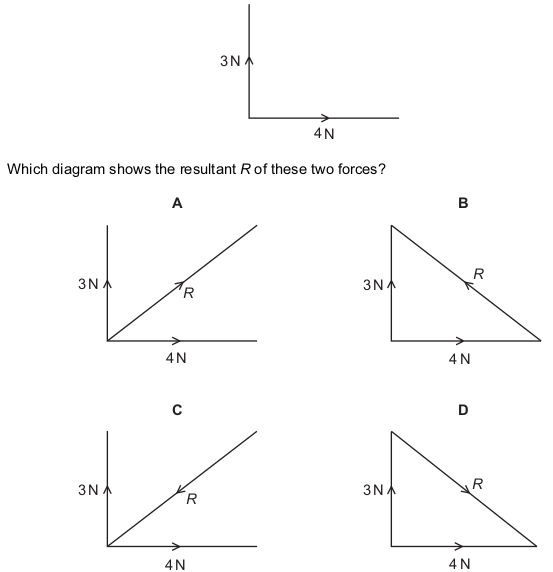
Forces of 3 N and 4 N act as shown in the diagram.
Question 20 of 21
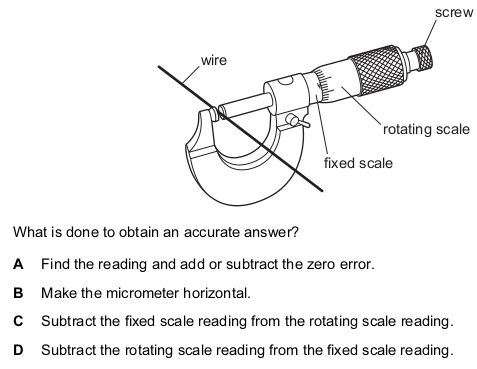
A micrometer is used to measure the diameter of a uniform wire.
Question 21 of 21
Before marking the finishing line on a running track, a groundsman measures out its 100 m length.
Which instrument is the most appropriate for this purpose?