1
Question 1 of 15
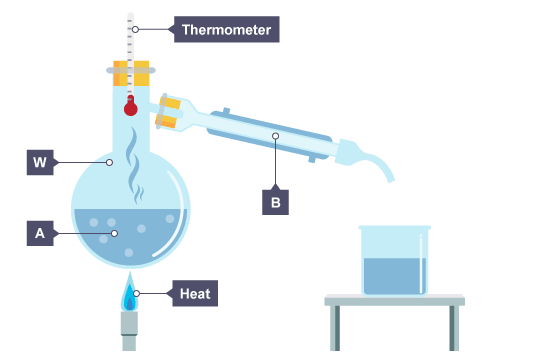
The apparatus in the diagram is used to separate a mixture of liquids in a fuel. What is apparatus W in the diagram?
This Organic chemistry quiz quiz contains 15 multiple choice questions designed to help you revise and test your Organic chemistry quizzes knowledge. Select an answer for each question and click “Submit Answer” to see instant feedback. Take your time and try to score as high as possible!
In this quiz, we are going to be looking at some major aspects of organic chemistry. Here, we shall cover some methods of separation of some organic mixtures, a study of hydrocarbons, identification of reactants, etc. It is going to be an exciting exercise going through the quiz.
Organic chemistry also known as the chemistry of carbon, is a branch of chemistry that studies the study of the structure, properties, compositions, reactions, and preparation of compounds containing carbon. This is one of the main branches of chemistry as a whole. Organic compounds form the basis for all life on earth as they constitute the majority of known chemicals. Also, the study of organic chemistry isn’t only limited to hydrocarbons, but also goes as far as involving the study of compounds with carbon and other elements.
This section of chemistry is very broad and needs to be studied with a lot of concentration. For this reason, this quiz was made to assist in achieving that goal. All you need to do is take the quiz and see how much you know and still need to know. We wish you the best.
Question 1 of 15
The apparatus in the diagram is used to separate a mixture of liquids in a fuel. What is apparatus W in the diagram?
Question 2 of 15
What is the name of this method of separation?
Question 3 of 15
What type of reaction is cracking?
Question 4 of 15
Which of the following is an alkane?
Question 5 of 15
Which of the following chemical reagents and reaction conditions is used in to 'breakdown protein into amino acids'?
Question 6 of 15
Which of the following chemical reagents and reaction conditions is used in the laboratory to convert 'ethanol to ethanoic acid'?
Question 7 of 15
Which of the following is called propane?
Question 8 of 15
Which of the following is a 'CRACKING' type of reaction?
Question 9 of 15
Which of the following is an 'ESTERIFICATION' type of reaction?
Question 10 of 15
Which of the following represents 'PHOTOSYNTHESIS'?
Question 11 of 15
Which of the following is a 'CONDENSATION POLYMERISATION' type of reaction?
Question 12 of 15
Which of the following represents 'PHOTOSYNTHESIS'?
Question 13 of 15
Which of the following is a 'ADDITION POLYMERISATION' type of reaction?
Question 14 of 15
Which of the following is called propan-1-ol?
Question 15 of 15
Which of the following is an alkene?