1
Question 1 of 17
The melting points and boiling points of substances A-D. Which is a solid at 20oC? [Substance] Melting Point oC and Boiling Point oC
This Heating and cooling quiz quiz contains 17 multiple choice questions designed to help you revise and test your A level Heating and Cooling Quizzes knowledge. Select an answer for each question and click “Submit Answer” to see instant feedback. Take your time and try to score as high as possible!
A level Heating and cooling quizzes are involved with Heating, Ventilation, and Air conditioning. These systems are often designed by engineers to maintain the comfort and safety of building occupants. Heating and air conditioning components assist us by controlling indoor climate and proper airflow, which ensures that we neither freeze nor sweat. You will learn a lot of fascinating stuff in this quiz about these two processes like temperature, ventilation, HVAC systems, and air conditioning. But our main focus will be on temperature especially.
Heating is simply defined as the process by which temperature increases. This occurs when there is an increase in kinetic energy of the particles of an object, or when the temperature changes from a lower temperature value to a higher temperature value. For example, cold water on fire gets warm to a higher temperature because it is being warmed(heating).
Cooling on the other hand is the opposite of heating, while temperature changes from low to high on heating, temperature drops from high to low when cooling is occurring. For example, water freezing to a temperature of below 4 degrees becomes ice.
To finish, A level Cooling and heating is very important for it opens students eyes to see the power of ventilation and air conditioning which deals with the comfortability of the human body when in a closed place, like a room. We should therefore take this topic in Physics seriously; most exams usually involve such topics. More quizzes are available on our official website, be sure to take the quiz and learn more.
Question 1 of 17
The melting points and boiling points of substances A-D. Which is a solid at 20oC? [Substance] Melting Point oC and Boiling Point oC
Question 2 of 17
Which temperature matches an ice and salt mixture?
Question 3 of 17
In winter freezing conditions can produce cracked milk bottles! In what way does water show UNUSUAL behaviour?
Question 4 of 17
Which temperature could be that of a bread oven?
Question 5 of 17
In winter, freezing conditions can produce cracked milk bottles! In what way does water show UNUSUAL behaviour?
Question 6 of 17
Problems can arise with railway steel track from changes in temperature. Small gaps are left between each rail section to allow for changes in length. Which of the following is TRUE about the steel rails and change in temperature?
Question 7 of 17
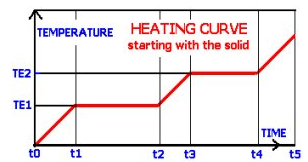
Starting with the solid, the graph shows the results of measuring the temperature of substance X as it was heated from a low to a high temperature. Which of the following is TRUE?
Question 8 of 17
The melting points and boiling points of substances A-D. Which substance is suitable to use in a thermometer that measures in the range 0 oC to 100 oC? [Substance] Melting point oC(mpt), Boiling Point oC(bpt)
Question 9 of 17
When water vapour in a cloud is gradually cooled, rainwater is formed. This change of state is called?
Question 10 of 17
Which of the following phrases about heat transfer properties best matches the use of steel for the base of a fryingpan?
Question 11 of 17
Which temperatures matches the boiling point of sea water?
Question 12 of 17
Which is represented by the particle picture above?
Question 13 of 17
The melting points and boiling points of substances A-D. Which is a solid at 100 oC? [Substance] Melting point oC(mpt), Boiling Point oC(bpt)
Question 14 of 17
Which of the following terms applies to what happens to dripping candle wax?
Question 15 of 17
Which of the following types of heat transfer matches using iron for a boiler?
Question 16 of 17
The melting points and boiling points of substances A-D. Which substance is suitable to use in a thermometer that measures in the range -4 oC to 50 oC? [Substance] Melting point oC(mpt), Boiling Point oC(bpt)
Question 17 of 17
Which is the opposite of melting?